.
 Continued from product
description on Traditional
Games' Page Two...
Continued from product
description on Traditional
Games' Page Two...
Historical
Background: Bowling games are among the oldest games in
the world. Archeologists have found stone bowling pins and balls
buried with the mummified remains of a child in Egypt who died
around 5000 B.C. Cavemen probably bowled at targets to increase
their skills at hunting. Ula Maika, an ancient Polynesian game,
was played with stone pins and balls. An ancient Roman version
of this game became known as "boccie," which is an
Italian form of what the British refer to as "lawn bowls."
In 12th-century England, lawn bowling was a popular pastime.
Indoor bowling began in German monasteries. The peasants who
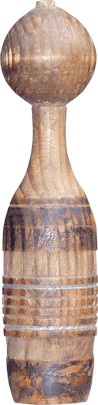
attended church always carried their big clubs called "kegels"
with them. When they attended religious services, the monks had
the peasants place their kegels at the end of a long narrow hallway.
In order to be absolved of sin, the peasant would have to roll
a round rock and knock down their club, which represented the
Devil. If they missed, they would have to mend their ways and
repent. The monks eventually made a fun game of this activity.
The word "kegling" is still used today for bowling
and "keglers" for bowlers.
Eventually, rolling stones at kegels lost its religious significance
and the wealthy adopted this game as a favorite pastime. Martin
Luther, who translated the Bible into German during the 16th-century,
was one such bowling enthusiast who encouraged a uniform set
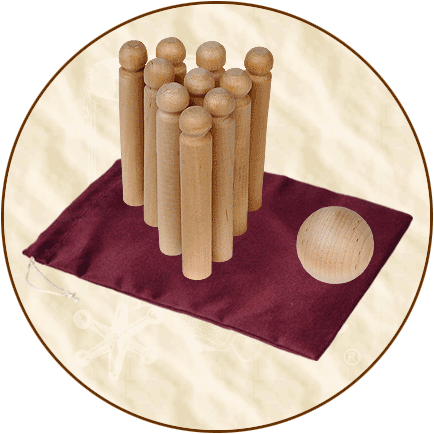
of rules. The game was officially called Kegelspiel or Nine-pins.
Soon the game spread from Germany to Holland and the Dutch brought
it with them when they settled in New Amsterdam (now New York
City). The earliest Virginia colonists loved the game so much
it interfered with their work. After Captain James Smith returned
to Jamestown, bowling was declared illegal and punishable by
up to three weeks in the stocks!
During the early 1800s, Nine Pins was such a favorite game
that it was played in many basements and back rooms of taverns.
Heavy gambling and betting were associated with the game and
soon it was outlawed. People, however, still enjoyed playing
this game. So, to get around the new law, they added another
pin and "ten pin bowling" was born. By 1895, the American
Bowling Congress was formed and they established official rules
and regulations.
Tabletop games rose in popularity when playing on the floor
of pubs and taverns was no longer feasible. Special tables were
made for games such as Skittles, Carom, and Crokinole. The table
game of Bagatelle (from the French word meaning "a trifle"
or "small thing") was also a popular game in the 19th
century. By 1920, Bagatelle evolved into the pinball machine.
Fun
Fact: By the 14th century, bowling was such a favorite
gambling activity that King Edward III banned the game so it
would not interfere with archery practice.







 10100 Park Cedar Drive, Suite 134
  Charlotte, NC 28210 USA
 (800) 871-1984
 (800) 871-1899
 info at historicalfolktoys.com
 Home
Page
Home
Page  Privacy Policy
  Contact
Information
Contact
Information  Legal Notices
  Site Map